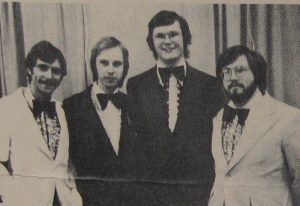
BOB DE LEON Receives MAMA’s Lifetime Achievement Award

San Diego salutes our own, Tom Kelly

 Before I had a star on the Hollywood Walk of Fame, I was a kid in San Diego with DJ dreams


Radio personality "Shotgun Tom Kelly" poses for a portrait at his home studio.
Radio personality “Shotgun Tom Kelly” poses for a portrait at his home studio.
(Meg McLaughlin/The San Diego Union-Tribune)

I once got to introduce President Ronald Reagan at a campaign rally in San Diego in 1984, later gave him one of my ranger hats, and in 2013 received a star on the Hollywood Walk of Fame.

Irwin, known as “Shotgun Tom Kelly,” is a longtime radio and television personality in Southern California and can be heard on SiriusXM 60s Gold(Channel 73) from 4 to 9 p.m. He is working on a book titled “All I Wanna Do is Play the Hits” and lives in San Diego County.

It’s been a more than a 50-year career, and it’s still going strong. I once got to introduce President Ronald Reagan at a campaign rally in San Diego in 1984, later gave him one of my ranger hats, and in 2013 received a star on the Hollywood Walk of Fame.

I was born and raised in San Diego and have always been proud to say that San Diego is my hometown. As young as 10, my dream was to be on the air in the radio industry, and I was very fortunate to have my dream realized when I was just 16. I was attending Mount Miguel High School in Spring Valley, and I was the school’s announcer every morning on “The Morning Bulletin.”


"Shotgun Tom" Kelly visits with President Ronald Reagan in the oval office in the late 1980s
“Shotgun Tom” Kelly visits with President Ronald Reagan in the oval office in the late 1980s
(Thomas Irwin )

Then, in 1966, I got my first on-air job at KPRI-FM playing standard music through a work-study program. At the time, FM was not the radio giant it is now. AM radio dominated the airwaves with stations like KCBQ and KGB-AM playing the hits, and that’s where I wanted to be, behind the microphone of a Top 40 radio station, playing those hits.

Shotgun Tom Kelly in radio school. It takes hard work to sound like a natural.

When I started, I needed a Federal Communications Commission first-class radiotelephone operator license to work at the big AM stations. So as soon as I graduated high school, I enrolled in the William B. Ogden Radio Operational Engineering School in Huntington Beach. I graduated from Ogden after six months with my first-class license, and I was on my way.

My first AM radio job was in Merced at KYOS-AM, then I worked at KACY-AM in Oxnard, and later, I was hired in Bakersfield at KAFY-AM.

It was in Bakersfield that I got a chance to host my first television kids show. I was “Nemo, the clown” every Saturday morning on KERO-TV, channel 23. I was in heaven. I was playing the hits and slowly making my way back to my hometown. One day, I got the nerve up to send an audition tape to Charlie Van Dyke, the program director of KGB-AM. He hired me for the 9 p.m. to midnight show. A year later, in 1971, I was the afternoon DJ at KCBQ-AM, at the same time I was asked to host “Word’s A Poppin,” a syndicated children’s game show on KGTV, channel 10. Now, I was working in two media industries, radio and television.

In the late 1970s, I worked at various radio stations in San Diego, including B100-FM and K-BEST 95, and in 1983 I began hosting the KUSI-TV “Kids Club.”

In the 1980s, Rep. Duncan Hunter reached out to me to voice his radio spots. He suggested that I present one of my ranger hats to then-President Ronald Reagan, and arranged for a presentation at the White House. It was an honor. President Reagan got up from the Resolute Desk, walked over and said, “Well, Shotgun, I hear you were the emcee in San Diego and kept the people entertained while they were waiting for me.”

I said, “Yes, Mr. President, and I bring you my ranger hat.” He put it on for a photo.

At that time, I started voicing radio and TV commercials. One of my commercial clients, Mad Jack’s, an electronics retailer, was selling a new piece of equipment, the Sony CD player. I was fascinated with the size of a compact disc and instantly wanted to replace all my dusty vinyl records. The player was portable, which was a new innovation. Of course, I immediately purchased one and installed one in my car.

In 1997, I got my big break and went to Hollywood at K Earth 101and succeeded one of my all-time radio heroes, “The Real” Don Steele.

I worked there for 20 years, and eventually was honored with a star on Hollywood’s Walk of Fame. Stevie Wonder was one of my presenters during the event.

Shotgun Tom, on the Hollywood Walk of Fame!

Working in Los Angeles, I had the opportunity to meet celebrities like Clint Eastwood, Regis Philbin, Vin Scully, Tom Jones, Elton John, Mike Love of the Beach Boys, John Stamos and many others. When I met Clint Eastwood, he knew who I was, and we talked about our favorite jazz DJ Chuck Niles. Regis Philbin and I talked about people we worked with at KFMB. To this day, Mike Love and I are good friends.

Now I work from a home studio and am on satellite radio. I am heard all around the world. I hope my Southern California listeners say, “Tom Irwin made good in San Diego and Hollywood.”

(Note:  Tom is a member of the Modesto Radio Museum, and for years was the station announcer, “The Voice” of the legendary Top-4o KFIV.)

*** To read the Museum’s tribute to Tom click here: “Quite a Ride, when you ride Shotgun.”  

***In his own voice, here are a few of Tom’s favorite radio memories: https://hollywoodandlevine.libsyn.com/ep142-meet-radio-star-shotgun-tom-kelly

OGDEN’S – Stan Atkinson Remembers


Stan Atkinson


Editor’s Note: This was part five in a series about local people connected to the early days of television.

When it comes to discussions about legendary figures in the history of local television, former TV anchor and reporter Stan Atkinson should always be in those conversations.
With a review of Stan’s awards alone, one can quickly gain an understanding that he was far from an average person in the field of journalism.

Stan Atkinnson, early days on television
Television was young and so was Stan Atkinson in the 1950s

Stan was a three-time Emmy Award winner and a recipient of both the World Affairs Council Award of Excellence for International Reporting and the Sacramento Region Community Foundation’s Lifetime Achievement Award. And these are just some of the awards that he has received.

Last week, Stan sat down in his Arden area home to discuss his journalism career, which spanned nearly a half-century. But before presenting details about that time, he spoke about the pre-media portion of his life. “I was born (in San Diego) on Nov. 11, 1932,” Stan said. “I was a peace baby, a Veterans (Day) baby.” After being asked to speak about his parents, Stan said, “It’s a long story, because I was adopted. I was raised by the Atkinsons – Stan and Bess Atkinson.”

Stan Atkinson, early days starting in radio
Stan began his broadcasting career in radio, in Los Alamos, New Mexico

Although most Sacramento area residents remember Stan for his television days, the majority of those people are not familiar with his relatively brief time working in radio.
In speaking about his first experience in radio, Stan said, “I was the sports editor of my high school newspaper and they started doing a radio show on Friday afternoons. So, I would do the sports segment, and I enjoyed it so much I ended up doing most of the show. I really liked it. I hadn’t had any experience with radio other than to listen to it. I was a high school senior then and I thought, ‘Well, I really like this and maybe this is something I could do (for a living) and should do.’ So, I announced to my father (the eldest Stan Atkinson) that I didn’t want to go to college.

I wanted to go to a school that would get you a first-class (Federal Communications Commission) license. My father was very disappointed, disgusted maybe, because he wanted me to go onto college and he had ideas of me becoming a lawyer. In disgust, he said, ‘Okay, I’ll give you the $300 to go to school.’ And he said, ‘And that’s it; then you’re on your own.’ I said, ‘Okay, good deal.’ So, I went to school (at the William Ogden Radio Operational Engineering School) in Burbank Calif.). I got the first-class license with great difficulty.”
Stan explained that after earning his first-class license in 1951, he had many employment opportunities in radio.

“Gosh, there were 200 jobs out there all over the country for the 25 of us who were in the (Ogden) class,” Stan said. “You pretty much had your pick.”

After reviewing his options, Stan decided that he would like to work for a particular, Armed Forces radio-founded radio station in Los Alamos, New Mexico.

To Stan’s delight, the station, after reviewing his audition disc, offered him a job.


Stan Atkinson

Stan lived a beautiful life, passing away in Sacramento in May, 2025, at age 92.

Remembering KDHS – Kenn Shearer, Student


Steve Falconer (standing) & Kenn Shearer at the controls of KDHS.

KDHS was an enigma to the general listening audience when it emerged on the Modesto airwaves on September 5, 1969. The station was licensed by the FCC to the Associated Students of Thomas Downey High School. The offices, studios & transmitter were located between rooms 50 & 51 at the high school. KDHS had the distinction of being the only high school radio station in the Modesto area, as well as one of the few high school radio stations in the entire country.

With Ron Underwood as the faculty advisor, KDHS was entirely student owned & student run. The radio broadcasting class was worth 1 credit as a vocational art. Its non-commercial, educational programming consisted of campus news, Downey High School Sports (especially football & basketball), special informational features, and a wide variety of popular music ranging from Rock & Roll to Jazz to Contemporary Christian.


KDHS student Carlene Scimeca
Rick Maze at the KDHS radio board

The original 4.5 watt transmitter served the station and the Modesto area quite well. In December of 1969, the station acquired a new 10 watt Sparta transmitter which enabled KDHS to be heard as far away as Riverbank, Empire, & Ceres. In 1972, Ron Underwood left Downey and took a teaching position at Beyer High School. There, he launched KBHI 88.9 FM, the second high school station in Modesto. Burt Vasche’ became the new faculty advisor at KDHS.

Since its inception, the student council had agreed to fund the radio station at a cost of $2,500 per year. This took care of most of the operating and repair costs. The students also sold local area businesses a “Booster Package” which consisted of a KDHS window sticker, and a “mention” on the air. Since the station was non-commercial, it could not run paid-for ads. Rather, it would mention a business in the same manner that most PBS stations do, (“Funding for this program provided by …”).

Bill Hines cues up a record at KDHS
KDHS student Sherry Corbin

Life went on at the little high school station until 1978. It was that year that 3 separate events signaled the start-of-the- end for KDHS:

Event #1…It was decided by the school district that the 1 credit radio broadcasting class would be discontinued at the end of the school year. Students would be allowed to continue broadcasting as an extra-curricular activity, but would not receive any class credit for their efforts. Graciously, Burt Vasche’ remained the faculty advisor for anyone who wanted to participate. It is believed that he did this without any pay or compensation from the school or district.

Event #2…The passage of Proposition 13, the Jarvis-Gann initiative, affected property taxes throughout the state, and in turn, dramatically reduced school funding. Athletic programs, the Arts, and extra-curricular activities took the biggest hit. In lieu of this shortfall, it was decided by the student council that they could no longer afford to continue to fund the station. The yearly stipend was immediately eliminated; however, the school continued to pay for the basic electricity used to keep the station on-the-air.

Event #3…While the station & students were reeling from the loss of funds, the FCC delivered the biggest blow by deciding to abolish all Class “D” FM stations (specifically, those operating at 10 watts). An overabundance of these low-powered, mainly high school & college radio stations were cluttering up the FM band, particularly in the 88-92 MHz range. An ultimatum was issued by the FCC; either increase your power to 100 watts, or leave the air. KBHI decided to do the latter. With no money for a new transmitter, no funding from the school, and a sharp decline in booster participation, KDHS was prepared to sign off for the final time. Instead, the station looked at a third option…one the FCC overlooked. KDHS decided to emulate KRJC, the AM station at Modesto Junior College. The transmitter was output reduced to 1 watt, and KDHS became a “Campus Carrier”. The signal could barely reach the outer edges of Downey Park to the north, and if you were more than 100 feet off campus, the signal was entirely lost. Furthermore, this meant that there was no protection by the FCC if a more powerful station petitioned to operate at the 90.5 FM frequency. Literally, on life support, the station remained on-the-air. The staff knew there was absolutely no money for repairs.

With the loss of the “1 credit class”, student participation had dwindled to a handful of believers. The listening audience at one time probably consisted of only one listener…the DJ on-air.

KDHS remained on the air until the spring of 1983. The once powerful 10 watt transmitter fell into severe disrepair and was unable to even crank out the single watt needed to remain on the air. The staff numbered less than 10, and the school insisted on reclaiming the office & studio space for a teacher preparation area. KDHS was officially gone.

When the license was allowed to expire, the Seventh Day Adventist Academy in Ceres petitioned the FCC in 1987 to acquire the 90.5 FM frequency. KADV, Your Christian ADVantage was launched in 1989. However, the call letters would not fade into obscurity. They were later claimed by Delta High School in Delta Junction, Alaska. In June of 2002, the FCC granted a license to KDHS-LP, a 100 watt high school station, which broadcasts at 95.5 FM, and on the internet.

Editor’s note: Kenn Shearer now lives in Tulsa, OK.

Remembering KDHS – Ron Underwood, Speech Instructor/Advisor

Remembering KDHS – Jeff Cree, Student

Remembering KDHS – Angie Decker Allen

Remembering KDHS – Mike Green, Student

Remembering KDHS – Les Simar, Student

Remembering KDHS – Ross Rumsey, Student

The Fillmore Auditorium

Memorabilia and Memories
of The Fillmore Auditorium
by Kathy Hansen

Museum Note:   Kathy Hansen, a member of the Modesto Radio Museum, has a lifelong connection to music. Her mother, Ramona Rae Hansen-Saben, owned Salty’s Record Attic in Modesto.  The cards shared in this article are from Kathy’s private collection.

The Fillmore, 1968
The Fillmore’s last show, 1968

The Fillmore Auditorium in San Francisco played host to some of the most iconic bands and performers of the ‘60’s. The Fillmore was built in 1912, at the corner of Geary & Fillmore, and was originally the home of the Majestic Hall and Academy of Dance. In 1936, it became the Ambassador Dance Hall. Then, in 1939, the name again was changed to the Ambassador Roller Skating Rink. In 1954, a successful business man by the name of Charles Sullivan began booking bands and the name became The Fillmore Auditorium.

In 1965, Sullivan let Bill Graham use his dance hall permit to book a benefit for the San Francisco Mime Troop and that is were the Fillmore history began

Jefferson Airplane performed the first non–benefit concert at the Fillmore, playing February 4,5 & 6 1966. They would follow up that concert two weeks later, by playing with Big Brother and the Holding Company and Janis Joplin. They headlined several more times at the Fillmore.
Jefferson Airplane was the first non-benefit concert held at the Fillmore

But a lot more than music came out of the walls of the Fillmore. There were the posters. If you are lucky enough to still have an original poster from those days, you have something really special.

Yards Birds – Doors,  James Cotton Blues Band, Richie Havens 1967 Artist – Bonnie MacLean #75 Postcard
Not only are the posters collector items because of the artists who appeared on them but also, in some cases, because of the artists who designed them. The artist who designed most of the psychedelic posters from February 1966 until May of 1967 was Wes Wilson. He geared the art toward the audience who would be attending. Some posters were inspired by his own experiences with LSD. He had a loosely exclusive arrangement with Bill Graham during that time but money disputes apparently caused them to part ways.
Paul Butterfield Blues Band, CREAM, South Side Sound System 1967 Artist—Bonnie MacLean #79
American Flag, American Music Band (Mike Bloomfield Guitar and Buddy Miles on drums), Moby Grape, Steve Miller Blues Band, South Side Blues Band 1967 Artist—Bonnie McLean #77

Wes Wilson (July 15, 1937 – January 24, 2020) was the father of the 60’s rock concert psychedelic posters. Between 1966 and 1968, Wes would complete 56 posters for Bill Graham. There is a popular story that Graham liked Wes’s first poster but he couldn’t use it because the text was not legible and supposedly Wes replied, “They’ll stop to read it because they can’t read it.” There began his stint with Graham.

The Mystery Trend, Big Brother and the Holding Company, Family Tree, Quicksilver Messenger Service, Gentlemen’s Band, Great Society, The Skins March 18 – 19 – 20, 1966.  Artist Wes Wilson BG-2
Grateful Dead, Big Mama Mae Thornton, Tim Rose, Country Joe Dec 9 – 10 – 11, 1966. Artist  Wes Wilson BG – 41
The posters also took on other forms. When you walked into a show, you were not only greeted with “Welcome to the Fillmore” but were given either a miniature 5 x 7 “Play Card” of the poster or a post card.

Jefferson Airplane Sept 14 – 15 1970 Fillmore West.  Artist – Pat Hanks Play Card
In 1968, due to the deterioration of the surrounding neighborhood, Bill Graham abandoned the Fillmore Auditorium.   In July of that year, Graham took ownership of the Carousel Ballroom on South Van Ness Ave.
It operated under the name the Fillmore West. He also had Fillmore East in New York City’s East Village. Both venues were closed in July of 1971 as the use of larger arenas grew in popularity.

The Fillmore continued on with a few different names: The New Old Fillmore, The Elite Club which became a venue for punk rock shows. It was reopened in the mid-‘80s under Bill Graham’s management but closed again in October of 1989 after the Loma Prieta earthquake damaged the building. After Graham was killed in the helicopter crash in 1981, it was reopened in 1994 after a Retrofit with The Smashing Pumpkins playing a surprise show. It is now leased and operated by Live Nation, a subsidiary of iHeart Media.


* Do you have memories of The Fillmore?  Please feel free to share them in the following comments section.


Have You Ever Called a Radio Station??

DENNY BROUGHER IS JAY MICHAEL STEVENS!


It was 1966. I was 16 years old, and top rated music station KHJ/930 AM Los Angeles California was doing a “Cash Call” contest. The cash prize, which grew larger at every incorrect answer, had just been won the previous hour, so it went back to a small amount ($10). I guessed wrong, and got the

Here it is! Denny’s long-lost album, or at least a photo.

consolation prize, which I wanted anyway. It was a souvenir KHJ Boss Radio record album, with pics of the KHJ jocks including Robert W Morgan, The Real Don Steele, and twelve songs from 1965 including “Gloria” by Van Morrison, Sonny and Cher’s “I Got You Babe”, and Barry McGuire’s “Eve Of Destruction”.

For someone who wanted to get into radio, this was better than winning the cash. Unfortunately, when I moved to Tucson, Arizona in 1970 for my first radio gig, my album collection and other stuff I left at home, was given to the Salvation Army.

“BORN TO BE MILD,” The Great K-5 Motorbike Giveaway.
Jay Michael Stevens, Don Shannon, Radio Rick Myers, and Captain Fred James

Now, fast forward to 1972. The tables were turned. I was 22 and just started working at top 40 radio station, KFIV, Modesto. We were giving away a Yamaha motorbike.      We took one caller every four hours to try and win it. The program director thought we could milk the contest for at least a couple of weeks. I had a winner the first evening of the contest. Program director was upset. Management was upset. And I thought I was going to get fired. The other more ‘seasoned’ jocks, thought it was funny. Especially when I put “Jane”, the winner, live on the air to congratulate her. After a few questions about how she felt winning a motorcycle, I asked if I could be the first one to ride with her. She answered with a very loud “NO!” I hit the radio station jingle and went straight to music.


Station management realized the contest needed to be reworked. Fortunately, the sales department got us a second motorbike. For this contest, we played the sound effect of a motorcycle throughout the day. We took the first caller’s name and phone number. All the contestants were then put into a barrel. After taking entries for a month or so, we had an on-air drawing for the “big” winner. This time around, the program director was happy. Management was happy. The advertiser was happy. And I continued working there for the next five years. But I never did get that ride on her new motorcycle.

(However, Jay DID get to sing at a piano bar):

Write us a letter, and we’ll sing you a song! Don Shannon, Radio Rick, Captain Fred James, Kenny Roberts, Larry Maher, Diane Cartwright, and J. Michael Stevens. 1976. KFIV

(And, he took a lot of requests)


Top 40 Radio Northern California

Dan Adams of KXTV 10 produced this story of Stockton and Sacramento Top 40 radio stations from days gone by; a time before corporate programmers dictated what to play and when to play it; a time when DJs had control and could make or break a record. Then things began to change. In 1966 there was a monumental shift and radio would never be the same again.

Top 40 Radio Northern California
Video by Dan Adams

Back To Video Vault Index

Kent Whitt and the Downbeats


Kent Whitt and the Downbeats was the first Modesto area rock ‘n’ roll band. Members of the band included Kent Whitt on drums, Bob DeLeon on Keyboard, Danny Toledo on Sax, Bill Gross on Bass, and Connie Hightman on Guitar. Kent Whitt and the Downbeats first formed to play school dances at Modesto High  and then became a popular draw in the area, playing the California Ballroom and the Fable Room as well as high school gyms.

Kent Whitt and the Downbeats played the California Ballroom, the Fable Room as well as many high school gyms.

The band developed quite a name for itself and in December of 1963 was invited to participate in a USO tour to entertain troops in Alaska, Japan, Taiwan, Korea, the Philippines, Okinawa, and  Vietnam. It was a five month tour which lasted until May, 1964.  While in Vietnam three members of the band got notice that he had been drafted.

In 2021 during an open house at the Graffiti USA Classic Car Museum Kent Whitt agreed to an interview with the Modesto Radio Museum.  Enjoy as he shares his memories with you.

Interview with Kent Whitt
video by Wes Page

Memories of Terry Nelson – Constance Nelson and Tricia Nelson-Milburn

Terry Nelson’s radio career began at KFIV in Modesto and from there he made stops at numerous radio stations across the country sharing his lovable sense of humor and his sharp wit. His laugh was infectious; he was the kind of guy that people wanted to hear everyday so they could get their Terry Nelson “Fix.”

The KFIV crew during Terry’s early days of radio.

The Modesto Radio Museum’s Derek Waring has been working closely with Constance Nelson, Terry’s wife and his daughter Tricia Nelson-Milburn to digitize many of Terry’s old airchecks and preserve these memories within The Modesto Radio Museum Website. Many thanks to Constance and Tricia for allowing us the opportunity to share samples of Terry Nelson’s radio career with our Modesto Radio Museum visitors.

Derek Waring with Constance Nelson, Tricia Nelson-Milburn and “cardboard Terry”

Constance and Tricia attended the Modesto Graffiti Days celebration in June of 2022 along with what they lovingly refer to as “cardboard Terry” which is a cardboard picture of Terry Nelson that was used to fill a seat at the Oakland A’s games during the COVID 19 shutdown. Terry was a big A’s fan. Cardboard Terry is now frequently seen beside Constance and Tricia at special events.

Terry Nelson

Terry passed away peacefully at home on May 26, 2020. There are many wonderful stories about Terry Nelson; Derek had the pleasure of asking Constance and Tricia to each share a personal favorite of theirs with us.

Memories of Terry Nelson – Constance Nelson and Tricia Nelson-Milburn
video by Wes Page

Back To Video Vault


Shotgun Tom Kelly – Broadcasting From The Sturgeon

In June of 2022 Modesto recognized  one of the “Power House” radio stations of the ’60s and ’70s. To many back then KFRC, The Big 610 was pumping out the hits for us from San Francisco because, truth be known, even though we were loyal to our local radio stations we would sneak over to 610 on the dial for our regular dose of Dr. Don Rose, Mike Novak, Bob Malik, Terry Nelson etc. After all some of these personalities were local guys and we had to support them, right?

Shotgun Tom Kelly is also a part of KFRC history and even though he is not a Modesto native he has strong ties to our community. Shotgun is best friends with KFIV’s Johnny Walker (Bob Neutzling) who was an on air personality at KFIV (K5) in the late ’60s, early ’70s. It was this connection that resulted in Shotgun Tom voicing the intros for the K5 disc jockies. Remember?

Shotgun Tom Kelly K5 Intro

Shotgun Tom is also connected to a number of Modesto DJs through Ogden’s Radio Operational Engineering School because they attended radio school together in the late ’60s. Through the years Shotgun has remained a good friend of ours and we are proud to say that he is a member of the Modesto Radio Museum.

Shotgun Tom and Modesto friends

We were excited to hear that Shotgun Tom Kelly was to be a part of the Modesto, 610 Day and that he was scheduled to broadcast from the historic KFRC, 610 Mobile Studio, the Sturgeon (it looks like a fish).

The Sturgeon in June 2022 during Graffiti Days celebration at the Graffiti USA Classic Car Museum
Shotgun Tom Kelly during Graffiti Days celebration at the Graffiti USA Classic Car Museum

Enjoy this video of Shotgun Tom broadcasting from The Sturgeon from Modesto in June of 2022. If you look closely you will see some of his biggest fans peering at him through the window.

Shotgun Tom Kelly – From the KFRC Sturgeon
video by Wes Page

Back To Video Vault

John Huey – How I Was Convinced To Go Into Radio

The “Midnight Honker” John Huey. He’s the KFIV on air personality that kept Modesto company through those long nights back in the late ’60s. John always boasts that he had better listener numbers from midnight till 6:00 AM than any other radio DJ in Modesto. He will also laughingly point out that  KFIV was the only station broadcasting from midnight to 6am back then.

We ran into John during the Graffiti Days celebration at the Graffiti USA Classic Car Museum in June of 2022. He took the mic as if he’d been doing it all of his life and proceeded to tell us the story of how he was convinced to go into radio by another well known Modesto radio personality.  Enjoy this video from the “Midnight Honker.”

Here’s the raw version of the KFIV jingle John Huey used:


JOHN HUEY – HOW I WAS CONVINCED TO GO INTO RADIO
video by Wes Page

Back to Video Vault Index